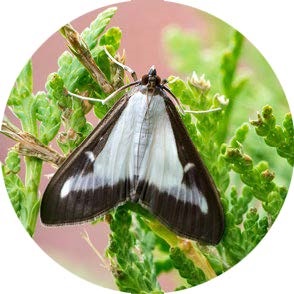
Wingspan 38-40 mm. Both wings white with purplish sheen and a broad bronze-brown border. Body predominantly white with head, prothorax & tip of
abdomen bronze-brown. Occasionally adults can be almost entirely brown with a pair of white spots on the forewings.
Larvae
Length up to 38 mm. Body mainly green and patterned with white & yellow stripes & a row of black, white rimmed spots. Head shiny black.
Eggs
Pale yellow to brown, 1mm in size, laid in gelatinous masses of 10-20 on the underside of leaves.
Distribution
Native to East Asia, and has now spread across central and southern Europe
Economic Host(s)
Leaves and occasionally bark of a wide variety of box tree (Buxus) species
Symptons/Signs
Larval feeding damage can be seen on leaf edges with sometimes only a leaf skeleton remaining. Webbing of branches with frass and exoskeleton residues (black head
capsules) are also signs. Bark feeding causes the plant to dry out and die.
Generations
2-3
Monitoring
Adults Present
April to October (climate dependent)
Recommended Trap Density
2-3 traps per hectare in large uniform areas or 3-5 traps per hectare if the area is less uniform (i.e. box trees/hedges amongst other vegetation).
Trap Maintenance
Check traps on a regular basis; at least twice a week. It is recommended to replace the pheromone dispensers every 5 weeks if using our standard lure or every 4 weeks
if using the rubber septum lure for peak performance.
Storage
Keep product away from heat and direct sunlight. Store in a refrigerator for a shelf life of 12 months or a freezer for an extended life of 18 months. Always store sealed in
original packaging.